
The holiday season is here. Your security team is ready. Your access controls are updated. Your surveillance is active.
But there’s a threat that doesn’t come through your doors, it comes through your networks.
Cyberattacks increase 30% during the holiday season. The average data breach costs over $4 million. For businesses built on community trust, a single breach can damage relationships that took years to build.
In our October 2024 “Comprehensive Guide to Holiday Security“, we covered physical security essentials. Today, we’re tackling the digital side; because comprehensive security means protecting every entry point, visible or invisible.
Why Holidays Create Perfect Conditions for Cybercrime
Extended hours. Tired employees. Temporary staff. Increased transaction volumes. Pressure to hit sales targets. Cybercriminals know your vulnerabilities spike during the holidays.
They exploit the chaos through:
- Phishing emails disguised as shipping notifications or vendor invoices
- Ransomware attacks when you can least afford downtime
- Point-of-sale malware capturing payment data during peak sales
- Data breaches that create PR nightmares at the worst possible time
Where Your Business Is Most Vulnerable
Email Phishing: The #1 Threat
90% of cyber breaches start with a phishing email. During the holidays, attackers disguise malicious emails as shipping confirmations, invoice updates, or urgent requests from “executives” who are traveling. One clicked link from an exhausted employee during the rush can compromise your entire network. The sophistication of these attacks makes them increasingly difficult to spot—they use real company logos, mimic vendor email addresses, and create genuine-sounding urgency.
Your Connected Systems
Modern access control and surveillance systems often connect to the cloud. Convenient? Yes. Secure by default? Not always. Building controls, like those that control HVAC systems, are just as vulnerable. A compromised access control system doesn’t just expose data, it can literally unlock your doors.
Payment Processing
Whether you manage retail tenants or process payments directly, compromised POS systems expose customer payment information, leading to liability and lost trust.
Your People
Employees check work email on personal devices. They click links in legitimate-looking emails. They plug in USB drives. Each action can introduce malware or provide network access to attackers.
Protecting Customer Trust
Your customers share their information believing you’ll protect it. During a season when breaches make headlines daily, security becomes a competitive advantage.
Best practices:
- Only collect data you actually need
- Encrypt sensitive information in transit and at rest
- Use HTTPS encryption on all websites
- Have a breach communication plan ready (transparency builds trust)
The Integration Advantage
Here’s where one-size-fits-one security truly matters: your cybersecurity shouldn’t exist separately from physical security operations.
Integrated reporting technology allows security teams to monitor physical and digital indicators simultaneously. Unusual digital access patterns might correlate with physical access attempts. Your community-rooted security team, familiar with normal patterns, can spot anomalies automated systems miss.
When selecting security solutions, prioritize platforms that integrate reporting across all security domains.
6 Practical Steps to Protect Your Business
1. Implement Multi-Factor Authentication Everywhere
Add MFA to email, financial accounts, and access control platforms. This single step prevents 99% of automated attacks. No excuses—just do it.
2. Secure Your Payment Systems
Ensure PCI DSS compliance for all payment processing. Work only with compliant processors that provide fraud detection. If you manage retail tenants, include cybersecurity requirements in lease agreements.
3. Update Everything, Right Now
Outdated software is an open door. Enable automatic updates for operating systems, antivirus software, and business applications. Don’t forget connected devices: security cameras, access systems, WiFi routers, and building management systems.
If you can’t remember the last update, you’re vulnerable.
4. Train Your Team on Holiday Scams
Hold pre-holiday training sessions focused on seasonal threats. Teach employees to:
- Verify unexpected requests for wire transfers or sensitive information
- Question emails asking for urgent action
- Report suspicious communications without fear of judgment
Consider simulated phishing exercises. When someone clicks a test link, use it as a teaching moment, not punishment.
5. Separate Your Networks
Guest WiFi must be completely isolated from business systems. Your point-of-sale systems shouldn’t share networks with administrative computers. Segmentation limits how far attackers can move if they gain initial access.
6. Backup Everything and Test Regularly
Implement the 3-2-1 backup strategy: three copies of data, on two different media types, with one copy off-site. But don’t just create backups—test them quarterly. A backup you can’t restore is worthless.
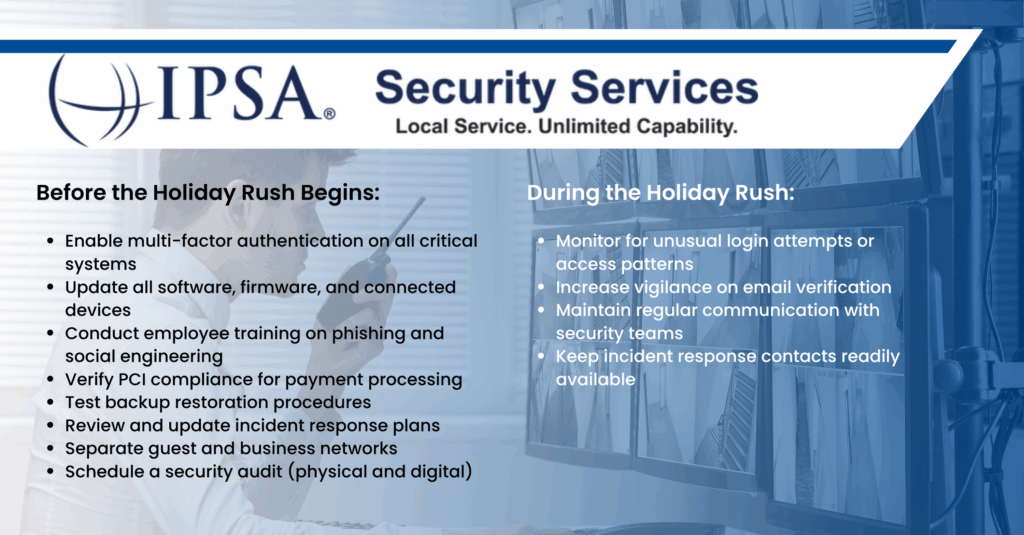
Your Holiday Cybersecurity Checklist
Beyond the Holidays
These practices shouldn’t be seasonal. Digital threats don’t take time off in January.
Use the holiday season as a catalyst to establish security practices that protect your business year-round. Strong cybersecurity, like strong physical security, becomes part of your operational culture—embedded in how employees think, how systems are designed, and how your organization responds to threats.
Moving Forward
This time of year should be a moment of celebration and gratitude, not anxiety about security threats.
Your physical spaces have security professionals who understand your unique needs. Your digital infrastructure deserves the same thoughtful, customized approach.
Because in today’s connected world, comprehensive security means protecting every aspect of your business—seen and unseen, physical and digital.
Ready to strengthen your security posture? Let’s talk about solutions designed specifically for your business.
Community-Rooted Security for a Digital World
At IPSA, we’ve built our reputation on understanding that security isn’t about generic solutions. It’s about your unique needs, your community, and your specific challenges.
A retail complex faces different cyber threats than an office building. A property with senior tenants requires different security communication than one serving tech-savvy young professionals. Your security solutions should reflect these realities.
By combining community expertise with integrated technology, we help businesses develop security strategies that protect what matters most: your people, your reputation, and the relationships you’ve built.