ARTICLE SUMMARY
Not all security guards are created equal. What separates a capable officer from a truly exceptional one isn’t just a license—it’s the training behind it. At IPSA Security Services, we believe an officer’s value to your facility begins long before they ever set foot on your property. From de-escalation techniques to site-specific knowledge, discover the training standards, ongoing education requirements, and performance expectations that define the IPSA difference.
Picture the last time someone walked into your building and something felt off. Maybe they were agitated. Maybe they were confused. Maybe they just didn’t belong.
Now picture the officer at the front who handled it. What did they do? How did they read the room? Did they make it worse or did they make it disappear?
That moment—quiet, unglamorous, over in three minutes—is exactly what security training is for. And it’s exactly where most security companies fall short.
The industry standard is a guard card and a post order. That gets you a body in a uniform. What it doesn’t guarantee is judgment, composure, or the kind of presence that makes people feel truly safe.
We asked four members of IPSA’s leadership team one direct question: what does it take to train an IPSA officer? Their answers cover everything from federal certifications to front-line de-escalation and they’re worth understanding before you sign your next contract.
THE FOUNDATION
More Than a Guard Card: The IPSA Baseline
In Arizona, security officers are required to maintain a valid guard card, a license that must be renewed every few years and includes mandatory coursework. That’s the industry floor. IPSA starts there and builds well above it.
What makes our baseline different is how we use that required renewal training as an opportunity, not just a checkbox. As Barb Lewis, IPSA’s HR Coordinator, explains:
“When I do the ongoing training for the guard card renewal class, I have a certain syllabus I must follow. However, I always try, especially for new guards, to incorporate IPSA Security Services’ core values, so they understand what makes IPSA special. I try to make it interactive, so I can get to know them as individuals.”
Barb Lewis, HR Coordinator
That human-centered approach to required training is a small but meaningful signal of something larger: at IPSA, we see training as a relationship-builder, not just a compliance activity.
THE CURRICULUM
What IPSA Officers Learn Before They Ever Patrol Your Property
IPSA officers complete a layered training curriculum that combines state-mandated education with IPSA-specific skills. Across our leadership team, a few core elements stood out:
Digital & Certification-Based Learning
Officers complete ongoing coursework through Target Solutions, a digital training platform used to maintain current knowledge of procedures, compliance topics, and safety protocols. In addition, officers complete:
- FEMA Incident Management coursework
- ATTSA Supervisor and Technician courses
- CPR, First Aid, and AED certification
- Annual driver training
As Operations Manager Michael Hutton notes, “Our ongoing education consists of online training through Target Solutions, with periodic quarterly training. We also retrain in CPR, First Aid, and AED every two years.”
Quarterly Hands-On Training & All-Hands Meetings
Beyond online learning, IPSA officers participate in additional training sessions and all-hands meetings.
These touchpoints ensure that training is not a one-time event, it’s a rhythm. And that rhythm keeps officers prepared for both routine situations and the unexpected ones that matter most.
THE PHILOSOPHY
Why We Never Stop Training: The Anti-Complacency Standard
Stagnation is a real risk in any security operation. When officers perform the same tasks day after day without new learning, they can become reactive rather than proactive. IPSA actively works against that tendency.
In Their Own Words: Why Continuous Training Matters
“Ensures officers do not become job stagnant. It allows officers to grow personally and professionally with garnered knowledge, so they can take advantage of upward mobility opportunities.”
— Doug Mills, Area Manager
“Continuous training is a good way to teach guards new techniques and different ways to handle situations—and it helps stop complacency.”
— Michael Hutton, Operations Manager
“To keep skills sharp and to make sure any new or changed policy procedures are always understood and adhered to.”
— Danielle Smith, Vice President
THE HUMAN SKILL
De-Escalation & Community Engagement: The IPSA Difference in Action
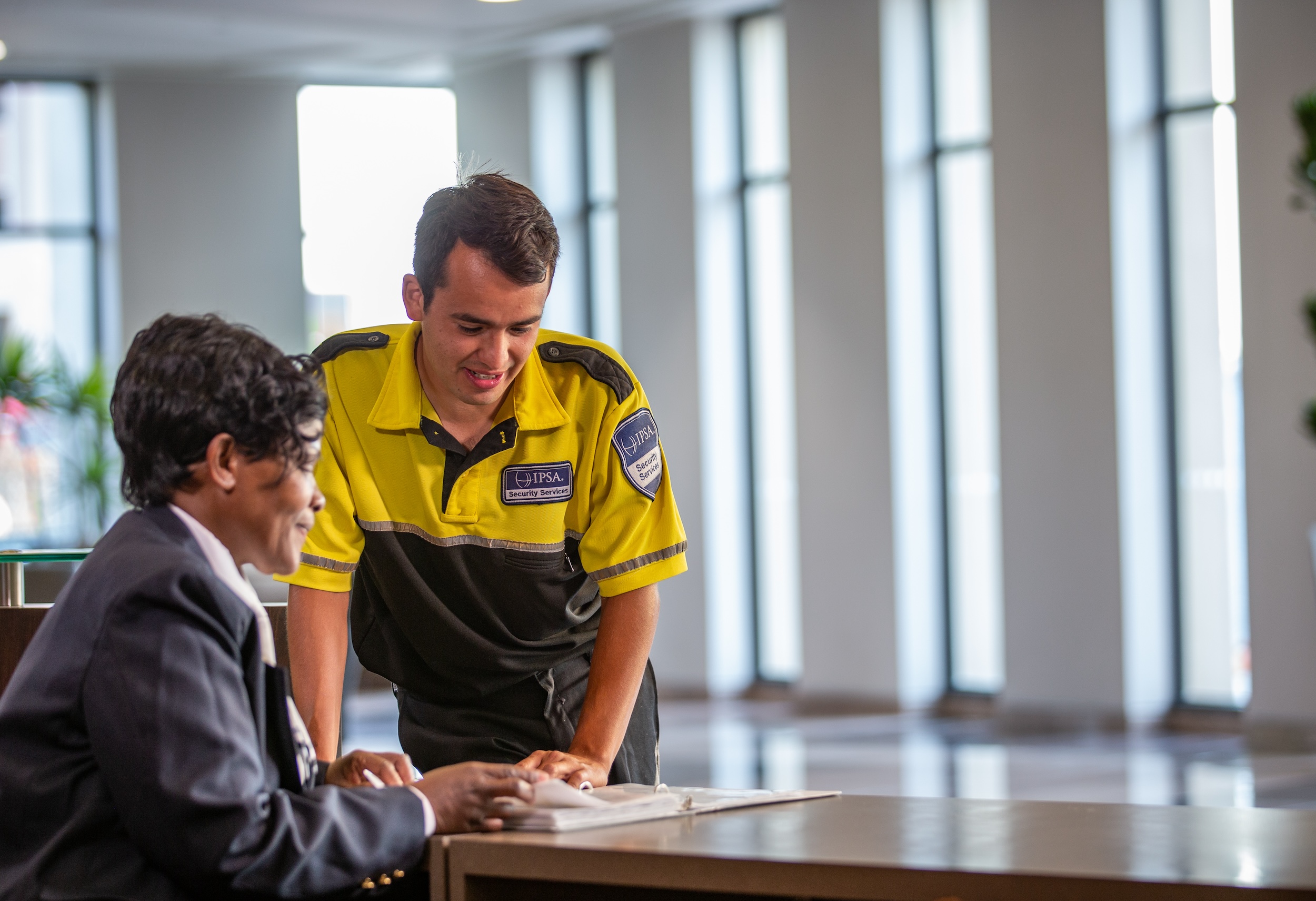
Technical certifications matter but in real-world security, the ability to communicate clearly and calmly in high-pressure situations is what separates a good officer from an exceptional one. IPSA invests heavily in this area.
“Great customer service and de-escalation skills are paramount to officer safety and ensuring clients have a ‘want to return’ experience.”
Doug Mills, Area Manager
Community engagement isn’t treated as a soft skill at IPSA; it’s core to the mission. Officers working in high-traffic environments like the Phoenix Convention Center regularly engage with diverse populations, including individuals experiencing homelessness or acute mental health crises.
“IPSA officers are trained to engage calmly and provide clear, concise, and firm instructions during interactions. Most interactions result peacefully. Over the years, PCC IPSA supervisors have thwarted suicide attempts by talking with and empathizing with individuals until first responders arrived.”
Doug Mills, Area Manager
That’s not a policy bullet point—it’s a real outcome of real training. And Operations Manager Michael Hutton reinforces how that culture is built saying, “Community engagement is prioritized in training by integrating local knowledge, building trust trough transparency and kindness.”
THE STANDARD
How IPSA Measures Officer Performance
For facility managers and property owners, accountability isn’t optional, it’s the baseline expectation. IPSA officers are evaluated across several areas that reflect both professional conduct and operational excellence:
- Attendance and punctuality
- Uniform and appearance standards
- Completion of all assigned training
- Patrol performance, including scan completion and site knowledge
- Client rapport and guest interaction quality
- Written counseling records, where applicable
IPSA’s integrated reporting technology supports these standards by providing transparent, real-time data on patrol activity and performance. This reporting gives clients visibility and officers accountability.
WHAT THIS MEANS FOR YOU
One Size Fits One—Training Included
At IPSA, we don’t believe in deploying officers with a generic checklist and wishing you well. Every client engagement begins with an understanding of your specific environment, your guests or tenants, your compliance requirements, and your goals.
That means the training your assigned officers receive isn’t just general security education. Their training includes site-specific context so that your IPSA team truly understands what it means to serve your property, your brand, and the people in your care.
When you’re evaluating security partners, ask them what they train for and how they prove it. At IPSA, the answer involves certifications, quarterly refreshers, community engagement standards, anti-complacency protocols, and a leadership team that believes in personal and professional growth for every officer on their team.
Want to discover more with the IPSA Education Series, check out:
The People Who Power IPSA’s Community-Rooted Security Solutions
Finding the Perfect Property Match for Our Unarmed Security Solutions
Building A New Security Approach From the Ground Up
Ready to experience the IPSA difference? Contact us to discuss a customized unarmed security program for your facility.
ipsasecurityservices.com | Phoenix, AZ & Austin, TX